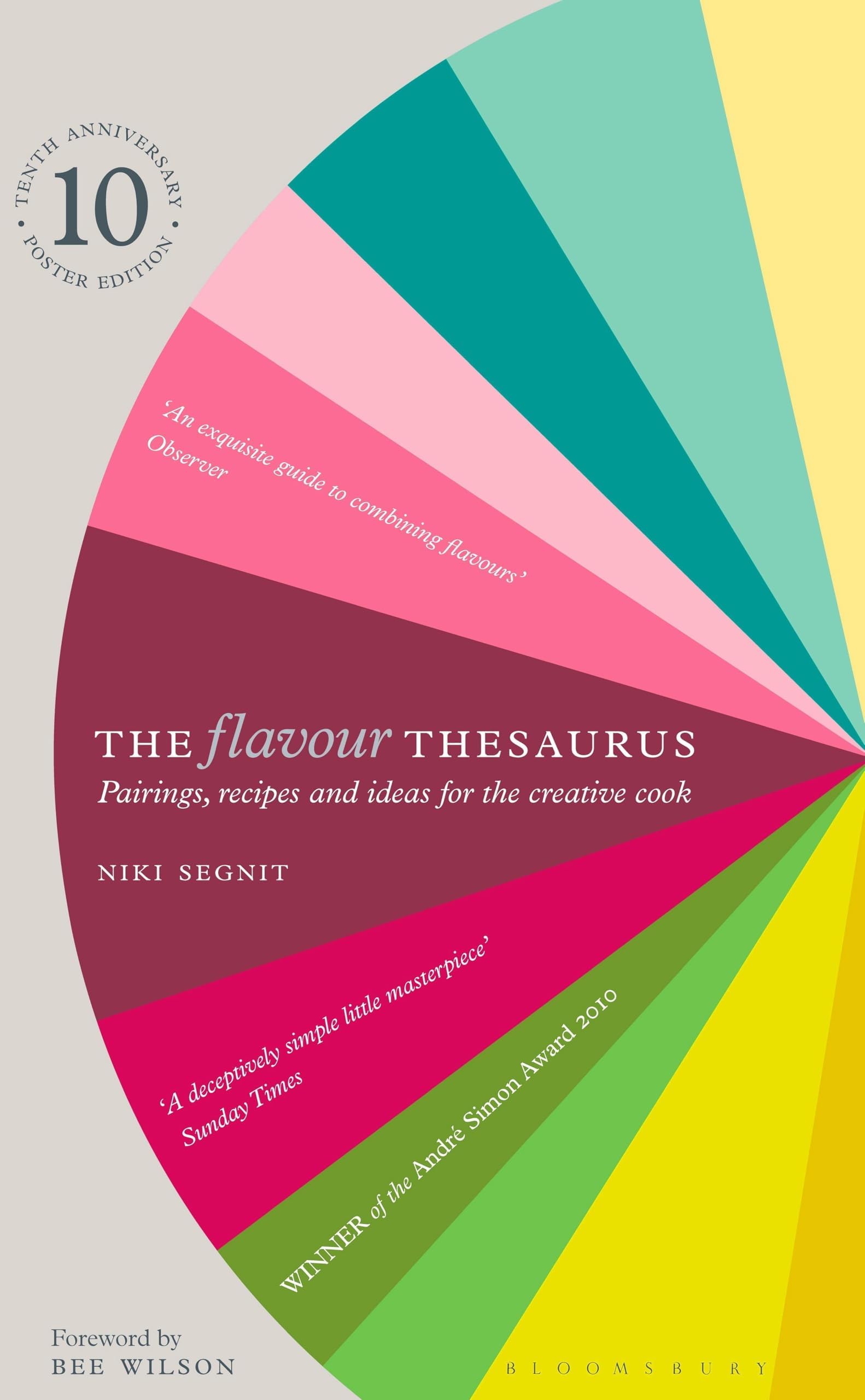
The Flavour Thesaurus
Product ID: 47972704
Buy anything from 5,000+ international stores. One checkout price. No surprise fees. Join 2M+ shoppers on Desertcart.
Desertcart purchases this item on your behalf and handles shipping, customs, and support to Mauritius.
'Delightful and informative ... packed with knowledge and information, but conveyed with such a lightness of touch' YOTAM OTTOLENGHI 'The books I value most are those I return to again and again. Such has been the case with The Flavour Thesaurus ' NIGEL SLATER 'An eclectic combination of dictionary, recipe book, travelogue and memoir ... A deceptively simple little masterpiece' SUNDAY TIMES Ever wondered why one flavour works with another? Or lacked inspiration for what to do with a bundle of beetroot? Well look no further... The Flavour Thesaurus was the first book to examine what goes with what, pair by pair, flavour by flavour. Divided into themes including Meaty, Cheesy, Woodland and Floral Fruity, Niki Segnit lists 99 popular ingredients, and for each one suggests unique flavour pairings that range from the classic to the bizarre. You will find traditional pairings such as pork & apple , lamb & apricot and cucumber & dill ; contemporary favourites like chocolate & chilli and goat's cheese & beetroot ; and interesting but unlikely-sounding pairings like banana & chicken , black pudding & mint , lemon & beef , blueberry & mushroom and watermelon & oyster . With nearly a thousand combinations, Niki also provides around 200 recipes and ideas throughout the book. Now featuring a new foreword by Bee Wilson and a fold-out poster of the flavour wheel, The Flavour Thesaurus is a highly useful, and covetable, reference book for cooking - it's the only kitchen companion you need. Can't get enough flavour pairings? Pick up a copy of The Flavour Thesaurus: More Flavours , the follow-up to the culinary sensation Review: Compulsive reading for all foodies, and the perfect present for keen cooks - This book has had stunning reviews in the national newspapers, and I decided to buy it as a present for my husband, the chef in our household. On the tube home, I had a quick flick through it out of curiosity...and I haven't been able to part with it since. The concept of `The Flavour Thesaurus' is utterly, utterly genius. Segnit has taken 99 basic flavours (mint, coriander, basil, strawberry etc) and researched 980 pairings of them. The result is part recipe-book, part food memoir, part flavour compendium. (The English Language geek in me feels compelled to point out that `thesaurus' is a misnomer - even similar flavours are NOT synonyms, jeez, though the book retains Roget's format). Some of these pairings are familiar, such as Bacon & Egg, whilst others (Avocado & Mango, anyone?) are not. Now and then, Segnit provides a recipe; many of these sound incredible, and despite being the most amateur of cooks, I reckon even I could manage many of them. Under Melon & Rose, for example, she merely tells you to drown a cantaloupe melon in rosewater syrup, so that it tastes like "a fruity take on gulab jamun". Can you even read that sentence without wanting to dash to the supermarket for the ingredients? Segnit also peppers the book with restaurant and dish recommendations - not in an insufferable shiny London lifestyle way, but in an enthusiastic, unpretentious, eating-out-with-your-mates "you really have to try this" way. If only she had supplied phone numbers so we could immediately make reservations. The real revelation, though, is Segnit's language. It is, quite simply, superb. Modern cookery writing seems to fall into three distinct camps: venomous snob, obsessed with tablecloths and ambience rather than the food itself; faux-geezer dahn the faux-pub; and flirty girl breathlessly enthusing over cake. With `The Flavour Thesaurus', Segnit may well have ended the careers of many of these over-hyped morons. For a start, her prose is endlessly entertaining. Breezy erudition sits alongside hilarious similes. She is a whizz with description: when she tells you that cloves on their own taste the same as sucking on a rusty nail, you half suspect she conducted a comparative taste test just to be sure. She incorporates references so wide-ranging that both Sybil Kapoor and Velma from Scooby Doo rate a mention. Then there are her unmissable riffs: p 148 instructs us on that "essentially unitary quantity, fishandchips", and insists they must be served in "newsless newspaper" (never polystyrene boxes) and always eaten at a bus stop or "on the wall outside the petrol station". Read about Instinctos and you will be snorting with laughter (and visiting Pizza Hut at the first excuse). I have now read `The Flavour Thesaurus' from cover to cover, and still I have not finished. I must temper my enthusiasm with a few tiny criticisms just to prove this is a genuine review. At nigh on £20 full price, it's expensive for a book without illustrations or photographs (though note desertcart has since discounted it). It assumes a certain level of prior culinary knowledge, which was sometimes frustrating to a novice like me, though it won't bother those with lots of cookbooks and greater competence in the kitchen. The integration of the recipes into the text - Elizabeth David and Simon Hopkinson style - can be irksome until you've got busy with post-it notes. The index needs further sub-division: `crab', for example, offers 11 entries in the index, but the recipe for crab cakes is easily missed under Butternut Squash & Bacon. But these are such minor complaints given the enormous appeal of this book. My husband hovers over it constantly, anxious for his promised present. My brother and my best friend have already asked to borrow it. `The Flavour Thesaurus' is truly a classic in the making, and no foodie's bookshelf is going to be complete without it. EDITED TO ADD, the husband (Latin geek) points out that 'thesaurus' means treasury. Well, whatever language you're using, this book is ACE. UPDATE - JANUARY 2011 Recently, the aforementioned husband, brother and I went to a "book dinner" organised by a local restaurant with recipes inspired by 'The Flavour Thesaurus', at which the author read from her book. Niki Segnit was lovely and exactly as she comes across in the text - funny, clever, and passionate about food in a very down-to-earth way. There was much discussion and disagreement about which flavour combinations worked, but most options on the menu were utterly delicious. If you get the chance to do this, I highly recommend the experience. UPDATE - FEBRUARY 2011 In response to comments below, my husband and I were both wrong - 'thesaurus' is Greek! Also, a fellow customer reviewer has expressed scepticism about the number of positive votes I've had for this review. I don't know why I've had so many votes (though I'm very grateful for the ones I've received), but I haven't been voting for myself, and I don't have 200 friends to vote on my behalf. In response to his/her insinuations, I also want to make clear I'm not related to this or any other author, nor paid by anyone - including desertcart - to submit reviews (more's the pity). Please also click on the link which leads to my other reviews so you can see that I regularly leave critical reviews as well as "effusive" ones. Of course other readers may disagree with my opinion of this book; but it has been a bestseller, and the author now writes for The Times, so I'm definitely not her only fan. As always, your mileage may vary. Review: Cannot rate this highly enough - This is easily one of favourite books. Full stop, end of. I had thought that a book like this surely already existed, but the closest that I knew of was Culinary Artistry by Andrew Dornenburg and Karen Page. However, The Flavour Thesaurus is just in a totally different league. Niki Segnit has really done her homework--for anyone interested in flavours, food, chemistry, gastronomy, history, international cuisine...this book really encompasses that many areas. It's a great reference book for experimental cooks--look up one of the 99 ingredients (which are also categorised in a beautiful chart grouping similar flavours together) and you'll find a little chapter wherein you'll be given flavours/ingredients it pairs well with, sometimes with an example from history or international cuisine, sometimes with an explanation based on chemical compounds, sometimes just with an anecdote, sometimes with a recipe suggestion. Don't let the words 'chemical compounds' put you off--nothing about this is dull or dry in the slightest. It is the sort of book that keeps you awake for hours longer than you intended, as you fall down the rabbit hole and follow links from one ingredient to another, often forgetting where you started completely...As I write, British asparagus season is peaking, so let me give you an example. Looking up asparagus (categorised as 'sulphurous'), I can see one of the pairings is asparagus and lemon, which is filed under lemon, and so takes me to the lemon chapter ('citrussy', of course). Talking about lemon and asparagus leads her to mention risi e bisi, an Italian dish of rice and peas--you're directed to the pea and hard cheese entry for details. While you're there you might notice that there is also a pea and asparagus entry...asparagus goes with lemon, which goes with peas, which go with hard cheese, which goes with asparagus...which all may inspire you to make a pea and asparagus risotto, perhaps finished with some grated parmesan and a flutter of lemon zest. Want to add a herb? You could look up lemon or peas or asparagus and see which herbs go with those ingredients. You can use this book to build your own recipes, as simple or complex and innovative as you want. I'm making myself hungry. That's an example of one of the more conventional pairings, but trust me there are plenty that are likely to be new to you and make you consider options that you otherwise wouldn't have. Anise and pineapple, perhaps, or watermelon and cinnamon? The writing is lighthearted while being incredibly informative, the anecdotes interesting, the recipes intriguing. If you really love food, you need this book. So brilliant that I have both the hardback and the Kindle versions, so that I always have it with me to browse during an idle moment.


| Best Sellers Rank | 3,620 in Books ( See Top 100 in Books ) 7 in Food & Drink Encyclopaedias & Dictionaries 278 in Home & Garden (Books) |
| Customer Reviews | 4.7 out of 5 stars 3,352 Reviews |
E**M
Compulsive reading for all foodies, and the perfect present for keen cooks
This book has had stunning reviews in the national newspapers, and I decided to buy it as a present for my husband, the chef in our household. On the tube home, I had a quick flick through it out of curiosity...and I haven't been able to part with it since. The concept of `The Flavour Thesaurus' is utterly, utterly genius. Segnit has taken 99 basic flavours (mint, coriander, basil, strawberry etc) and researched 980 pairings of them. The result is part recipe-book, part food memoir, part flavour compendium. (The English Language geek in me feels compelled to point out that `thesaurus' is a misnomer - even similar flavours are NOT synonyms, jeez, though the book retains Roget's format). Some of these pairings are familiar, such as Bacon & Egg, whilst others (Avocado & Mango, anyone?) are not. Now and then, Segnit provides a recipe; many of these sound incredible, and despite being the most amateur of cooks, I reckon even I could manage many of them. Under Melon & Rose, for example, she merely tells you to drown a cantaloupe melon in rosewater syrup, so that it tastes like "a fruity take on gulab jamun". Can you even read that sentence without wanting to dash to the supermarket for the ingredients? Segnit also peppers the book with restaurant and dish recommendations - not in an insufferable shiny London lifestyle way, but in an enthusiastic, unpretentious, eating-out-with-your-mates "you really have to try this" way. If only she had supplied phone numbers so we could immediately make reservations. The real revelation, though, is Segnit's language. It is, quite simply, superb. Modern cookery writing seems to fall into three distinct camps: venomous snob, obsessed with tablecloths and ambience rather than the food itself; faux-geezer dahn the faux-pub; and flirty girl breathlessly enthusing over cake. With `The Flavour Thesaurus', Segnit may well have ended the careers of many of these over-hyped morons. For a start, her prose is endlessly entertaining. Breezy erudition sits alongside hilarious similes. She is a whizz with description: when she tells you that cloves on their own taste the same as sucking on a rusty nail, you half suspect she conducted a comparative taste test just to be sure. She incorporates references so wide-ranging that both Sybil Kapoor and Velma from Scooby Doo rate a mention. Then there are her unmissable riffs: p 148 instructs us on that "essentially unitary quantity, fishandchips", and insists they must be served in "newsless newspaper" (never polystyrene boxes) and always eaten at a bus stop or "on the wall outside the petrol station". Read about Instinctos and you will be snorting with laughter (and visiting Pizza Hut at the first excuse). I have now read `The Flavour Thesaurus' from cover to cover, and still I have not finished. I must temper my enthusiasm with a few tiny criticisms just to prove this is a genuine review. At nigh on £20 full price, it's expensive for a book without illustrations or photographs (though note Amazon has since discounted it). It assumes a certain level of prior culinary knowledge, which was sometimes frustrating to a novice like me, though it won't bother those with lots of cookbooks and greater competence in the kitchen. The integration of the recipes into the text - Elizabeth David and Simon Hopkinson style - can be irksome until you've got busy with post-it notes. The index needs further sub-division: `crab', for example, offers 11 entries in the index, but the recipe for crab cakes is easily missed under Butternut Squash & Bacon. But these are such minor complaints given the enormous appeal of this book. My husband hovers over it constantly, anxious for his promised present. My brother and my best friend have already asked to borrow it. `The Flavour Thesaurus' is truly a classic in the making, and no foodie's bookshelf is going to be complete without it. EDITED TO ADD, the husband (Latin geek) points out that 'thesaurus' means treasury. Well, whatever language you're using, this book is ACE. UPDATE - JANUARY 2011 Recently, the aforementioned husband, brother and I went to a "book dinner" organised by a local restaurant with recipes inspired by 'The Flavour Thesaurus', at which the author read from her book. Niki Segnit was lovely and exactly as she comes across in the text - funny, clever, and passionate about food in a very down-to-earth way. There was much discussion and disagreement about which flavour combinations worked, but most options on the menu were utterly delicious. If you get the chance to do this, I highly recommend the experience. UPDATE - FEBRUARY 2011 In response to comments below, my husband and I were both wrong - 'thesaurus' is Greek! Also, a fellow customer reviewer has expressed scepticism about the number of positive votes I've had for this review. I don't know why I've had so many votes (though I'm very grateful for the ones I've received), but I haven't been voting for myself, and I don't have 200 friends to vote on my behalf. In response to his/her insinuations, I also want to make clear I'm not related to this or any other author, nor paid by anyone - including Amazon - to submit reviews (more's the pity). Please also click on the link which leads to my other reviews so you can see that I regularly leave critical reviews as well as "effusive" ones. Of course other readers may disagree with my opinion of this book; but it has been a bestseller, and the author now writes for The Times, so I'm definitely not her only fan. As always, your mileage may vary.
A**R
Cannot rate this highly enough
This is easily one of favourite books. Full stop, end of. I had thought that a book like this surely already existed, but the closest that I knew of was Culinary Artistry by Andrew Dornenburg and Karen Page. However, The Flavour Thesaurus is just in a totally different league. Niki Segnit has really done her homework--for anyone interested in flavours, food, chemistry, gastronomy, history, international cuisine...this book really encompasses that many areas. It's a great reference book for experimental cooks--look up one of the 99 ingredients (which are also categorised in a beautiful chart grouping similar flavours together) and you'll find a little chapter wherein you'll be given flavours/ingredients it pairs well with, sometimes with an example from history or international cuisine, sometimes with an explanation based on chemical compounds, sometimes just with an anecdote, sometimes with a recipe suggestion. Don't let the words 'chemical compounds' put you off--nothing about this is dull or dry in the slightest. It is the sort of book that keeps you awake for hours longer than you intended, as you fall down the rabbit hole and follow links from one ingredient to another, often forgetting where you started completely...As I write, British asparagus season is peaking, so let me give you an example. Looking up asparagus (categorised as 'sulphurous'), I can see one of the pairings is asparagus and lemon, which is filed under lemon, and so takes me to the lemon chapter ('citrussy', of course). Talking about lemon and asparagus leads her to mention risi e bisi, an Italian dish of rice and peas--you're directed to the pea and hard cheese entry for details. While you're there you might notice that there is also a pea and asparagus entry...asparagus goes with lemon, which goes with peas, which go with hard cheese, which goes with asparagus...which all may inspire you to make a pea and asparagus risotto, perhaps finished with some grated parmesan and a flutter of lemon zest. Want to add a herb? You could look up lemon or peas or asparagus and see which herbs go with those ingredients. You can use this book to build your own recipes, as simple or complex and innovative as you want. I'm making myself hungry. That's an example of one of the more conventional pairings, but trust me there are plenty that are likely to be new to you and make you consider options that you otherwise wouldn't have. Anise and pineapple, perhaps, or watermelon and cinnamon? The writing is lighthearted while being incredibly informative, the anecdotes interesting, the recipes intriguing. If you really love food, you need this book. So brilliant that I have both the hardback and the Kindle versions, so that I always have it with me to browse during an idle moment.
S**Y
An inspiring and witty read.
When I first ordered this book, I had decided I was at a point in my cooking "career" where I wanted to experiment more and start making up my own recipes. I was very aware, however, that I had very limited knowledge of flavour combinations. That's when I heard of this book. I did some research, but it had only recently been published and there wasn't a whole lot of press about it, so I decided to buy this and another, similar sounding book, the American "Flavor Bible". On receipt of my two new books, I knew immediately which I preferred. This Flavour Thesaurus was relatively small (although thick), with no pictures and made from what felt like very low-grade paper. The Flavor Bible, in contrast, was big, glossy, with luxurious paper and filled with pictures. So, that was the one I picked up first. It was a fun read, albeit based around American chefs and restaurants that I had never heard of, but after only a few pages, the prose stopped and we ended up with nothing but table after table of flavour combinations. What a disappointment. I put it to one side and picked up The Flavour Thesaurus. Two hours later, I hadn't managed to put it down and I had well and truly fallen in love with it. It is a truly inspirational book. The witty stories and observations for each and every combination make up for the roughness of the pages; in fact, after a while, this seems to add to the book's charm. It is matter-of-fact, down-to-earth, rather cheeky at times; a good, honest book that doesn't need to apply layers of gloss to sell it. The author herself gives opinions on the combinations in the book, not all of them entirely complimentary, which adds to the absolute humanity of the book. I really didn't consider that it would be possible to read a book on this subject from cover-to-cover, but that is precisely what you can do. It reads like a collection of short stories from around the world, each one tempting you with thoughts of the flavours, so vivid at times that you can almost taste them. Alternatively, it can be picked up and used like a reference book. If you fancy a spot of goat's cheese for lunch, consult The Flavour Thesaurus and see what you could be tempted to accompany it with. Something traditional like apricot or basil perhaps? Or why not try something different? Segnit suggests goat's cheese and chilli. Or goat's cheese and chocolate? Well, since everyone knows that chilli and chocolate are natural partners, why not combine all three?
C**W
Welcome, but still waiting for a definitive guide
Food writing of this sort, discussing flavours and encouraging inventiveness rather than trotting out fixed recipes with no guidelines for variation, is a vastly underdeveloped sub-genre. Some while ago I had purchased The Flavor Bible (TFB), which while useful has certain limitations - see my review of that book. On coming across this new book by accident whilst browsing I stuck a pre-order in straight away. Rather than being arranged alphabetically, like TFB, this book is arranged by categories - "roasted", "meaty", "cheesy", "earthy" and so on, but there is an alphabetical index. TFB sometimes has a problem of asymmetry, that is, if flavour A was listed as matching with flavour B, then it would not necessarily list the reverse. Thankfully, this current book does not appear to have that problem. The foodstuffs covered are not as comprehensive as TFB, there are only 99, but some common flavours which go with many things have been omitted - pepper, vinegar and so on. There are not so many matches listed with each flavour as TFB has; many of the flavour combinations appear to be derived from tried and tested recipes, so are largely "safe" rather than there being many "experimental" pairings, though there are a few oddities to be found (cauliflower and chocolate, anyone?). But whilst TFB was simply comprised of lists, this current book has a sizeable paragraph of notes with each entry which is a bonus, although sometimes the notes can ramble on at great length about, for example, holidays Ms Segnit has been on, rather than sticking to the point, namely food. And comparing flavours to spaceships in "Close Encounters of the Third Kind" or the "wooh wooh" sounds in the Rolling Stones' "Sympathy for the Devil" may float some people's boat, but just doesn't do it for me. Rather it just makes me think "Ugh...". This kind of approach very much reminds me of the excruciatingly irritating style used in Laura Santtini's Easy Tasty Italian , which there, as here, detracts from what is actually quite a good book. Overall my assessment would be that this is a better book than TFB, but far from being a definitive guide; personally I wouldn't regard it as a replacement for TFB. To some extent they could be considered as complementary to each other, and I'll certainly make use of both.
A**S
thought provoking
Thought provoking and enjoyable read. I sometimes check it out for possible combos. Maybe more useful in theory than in practise?
I**A
Perfect for jazzing up the Seignalet diet !
Perfect for jazzing up the very restricted Seignalet diet as per How to prevent & reverse 100 diseases the new French way with Dr. Seignalet's diet miracle: Obesity - Arthritis -Migraines - Depression -MS -Crohn's - ... Fibromyalgia - Acne - Psoriasis - Lupus etc. ". At first glance what does a book made for foodies and chefs have to do with a strict diet to heal your leaky gut and reverse whatever disease you have? Well just because you are following a strict diet to prevent or reverse disease does not mean that you have to forego the pleasure of eating. It's really not that difficult to make Niki's fabulous flavour combinations "Seignalet legal". Two of my Segnit/Seignalet dinner party standard (well I think so anyway) recipes: Segnit recommendations for accomanying white fish: beetroot, parsnip, coco nut. My S/S recipe: Cut a filet of white fish into small pieces. Cut the raw beetroot and parsnip into ultra thin slices with a mandolin (I like to add some mushrooms too, mandolin sliced of course). Put the whole lot in a pan with some virgin coco nut oil on ultra low heat and the lid on. Cook for a few minutes until everything is just soft. Keep all the juices from the pan. I add some fermented coco nut cheese which I make from 1 coco nut, the fresh, raw juice of one granny smith (you will need a juicer - I use a Green Power), several large tablespoons fulls of home made sauerkraut. The coco nut cheese is made well in advance of course in large batches and put into Kilner jars (I do 15 coco nuts at a time) and left for a week to ferment nicely and turn into cheese. Add a very generous dollop of the cheese to the pan juices to make a lovely sauce. Fantastic! What to eat with parma ham or bresaula? Turn to the Flavour Thesaurus. Asparagus. Of course! Why didn't I think of that. A perfect combination. You need never run out of inspiration ever again. Just turn to the Thesaurus.
M**E
Great gift for budding chefs
I like this book. It's fun to flick through. Quirky. A point of interest on the shelf. I wouldn't say I used it regularly but if you work in catering or throw fancy dinner parties then I'm sure it would give you some ideas! A nice gift (but check they haven't got a copy already!)
A**R
Definitely improved my cooking
Get this book! Stuck on ideas on what ingredients match well with then this book is for you. I keep getting surprised after owning this for years. Definitely recommend this.
C**O
inesauribile fonte di idee
Me lo sono messo pure sull'iPhone. Quando mi serve l'ispirazione per un piatto nuovo lo apro. Ormai lo so quasi a memoria. Quando esce il prossimo?
C**A
Excelente Estruturação - Excelentes Sugestões
Para quem já domina técnicas de cozinha; Para quem já possui vários livros de Receitas; Para quem quer dar um charme especial ou recriar um prato tradicional; Este livro é excelente. Sugiro ainda 4 livros que trabalham estas questões: The Flavor Bible; The Flavor Matrix; The elements of taste; Exemplo de resultado obtido: Mousse de Chocolate com Cardamomo. Há 3 receitas que faço a do Claude Troigros (só ovos), a do Laurent Suaudeau (só creme de leite) e do Joel Robuchon (ovos e creme de leite) todos crescem.
I**.
Innovative
Creativity
B**T
Un libro de cocina muy original y bueno
Un libro muy bueno y diferente de cocina en el que podrás saber qué ingredientes van con otros. Muy bien. Escrito
D**R
買って良かったです
とても参考になる本だと思います。日本人にも常識的な知識もあれば、想像もつかなかった味の組み合わせも沢山掲載されています。興味のあるものから試していくつもりです。洋書では一般的ですが、全て文字での解説で、ダイアグラムはあっても図解や写真などはありません。
Trustpilot
3 weeks ago
2 days ago